· 7 min read
Conferências Virtuais TeMA 2026
Saiba mais sobre a edição 2026 das Conferências Virtuais da TeMA.
Conferências TeMA 2026
Associados,
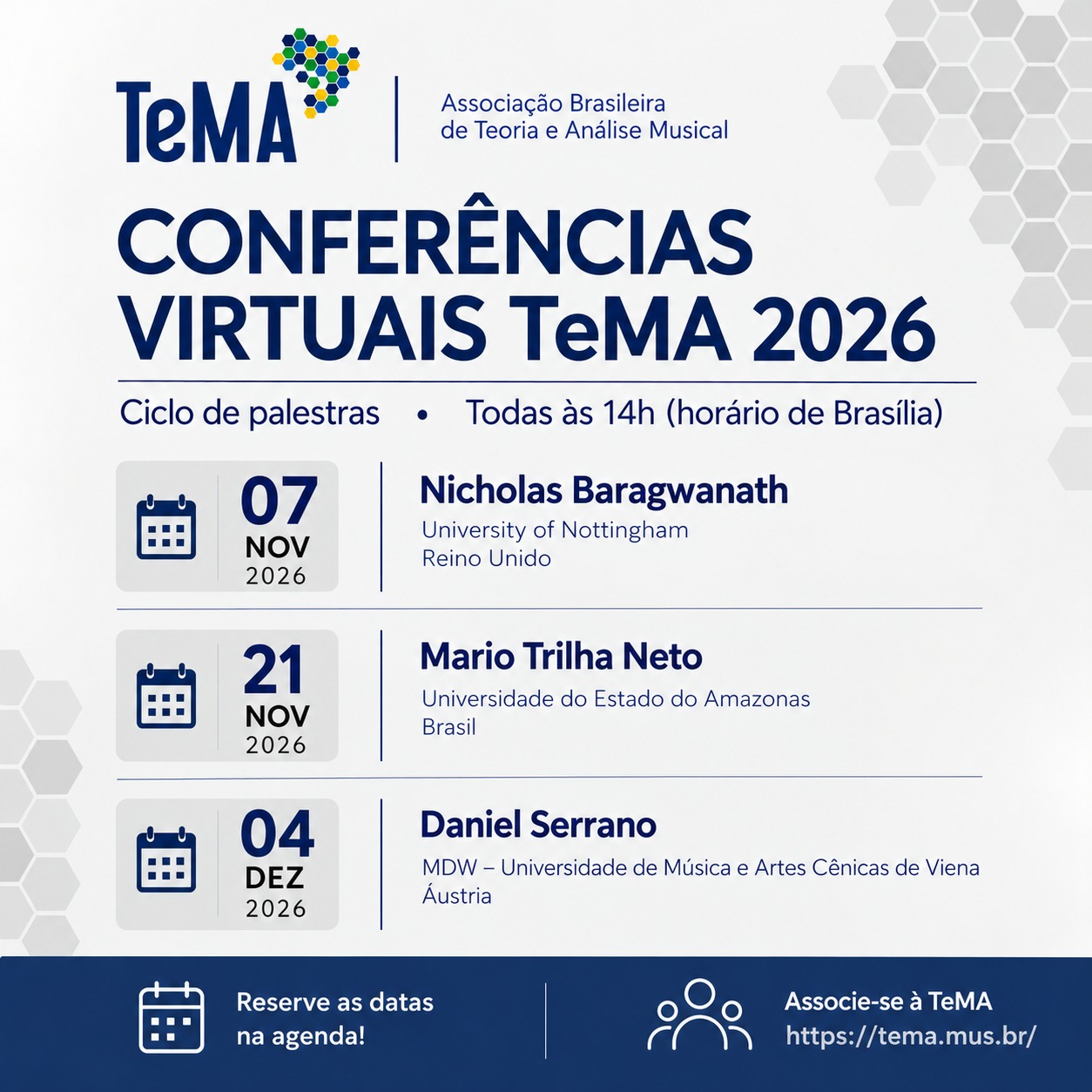
Segue a divulgação da edição 2026 do ciclo de Conferências Virtuais da TeMA. Reiteramos nossos agradecimentos aos palestrantes, que se dispuseram a compartilhar de forma generosa seus conhecimentos com os associados da TeMA.
Os links para YouTube (público em geral) e Zoom (associados) serão divulgados em breve.
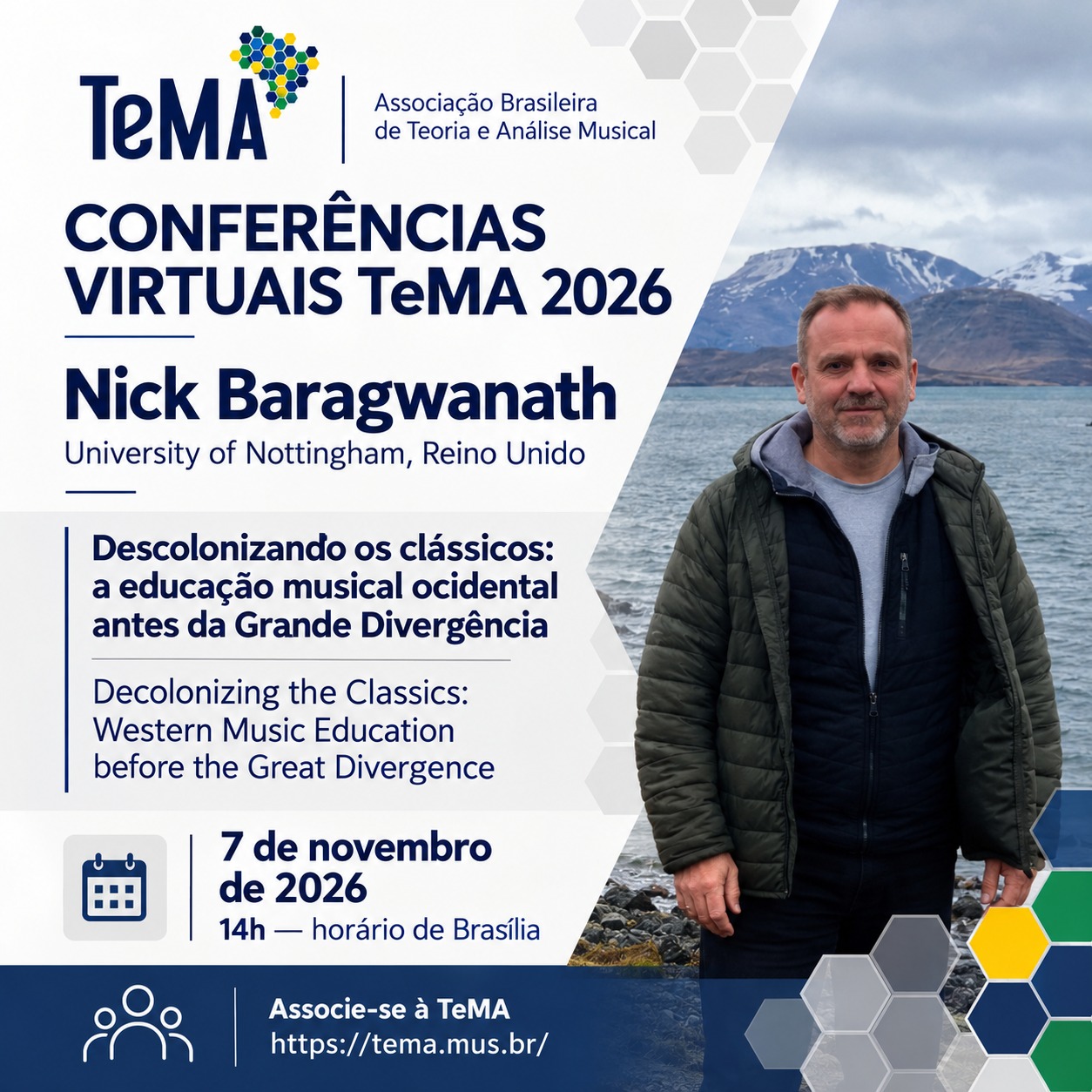
Nick Baragwanath: “Decolonizing the Classics: Western Music Education before the Great Divergence”
Data: 07/11/2026 - Horário: 14 horas (GMT -3)
Link (YouTube): em breve!
Resumo:
For two centuries the music of eighteenth-century Europe, from Bach to Beethoven, has enjoyed “Classical” status. Entire theories (of tonality, sonata form, etc.) have been established to try to prove its superiority. Yet this repertory predates the socio-economic “Great Divergence” (Pomeranz 2000), during which Western Europe and its North American settler colonies rapidly outpaced the rest of the world in industrialization, wealth, and technological power, thus ending centuries of comparable global prosperity based on artisan/craft modes of production. In this talk, I argue that European musicians from Bach to Beethoven learned their craft much like musicians in other parts of the globe and enjoyed similar status. Like their counterparts producing bespoke music for courts and religious institutions on other continents, they were artisans: purveyors of a pre-industrial craft, acquired through years of apprenticeship, to a known, elite clientele. Such skills were normally learned through oral tradition. To back up this claim, I decode the first three years of lessons delivered at the conservatory in Naples in 1755, when it was the most respected music school in Europe. The results show that they learned in much the same way as court musicians in, say, India or Persia. What we call ‘form’ was learned through rhythm, for instance, through a system established in the early 1300s. Melody was learned as a language, with ‘words’ and ‘phrases’ that could be adapted to suit different styles.
Sobre o palestrante:
Nick Baragwanath é Professor de Música na University of Nottingham, Reino Unido. Sua pesquisa abrange uma ampla variedade de temas, do período Barroco à atualidade. Recebeu o Westrup Prize, da Oxford University Press, em 2006; o Emerson Prize, da Mozart Society of America, em 2014; e o prêmio de Publicação Multi-autoral de Destaque, da Society for Music Theory, em 2025. Atualmente, está concluindo um guia sobre o solfejo italiano do século XVIII, provisoriamente intitulado Foundations of Composition and Improvisation in the Galant Style.
Mário Trilha: “Antigas/novas fontes como estratégia para o ensino musical: harmonia, contraponto, partimento e improvisação”
Data: 21/11/2026 - Horário: 14 horas (GMT -3)
Link (YouTube): em breve!
Resumo: No primeiro quarto do século XXI, contribuições teóricas baseadas em fontes primárias dos séculos XVII, XVIII e XIX abriram novas possibilidades para o ensino musical. Um exemplo significativo é o revival da tradição do partimento, ocorrido nas últimas décadas e intensificado nos últimos 15 anos. Essa prática integra composição e performance, mantendo teoria e prática indissociáveis. O partimento oferece uma formação ampla em composição musical por meio da improvisação, abrangendo baixo contínuo, harmonia, contraponto, forma, textura e coerência motívica. Em 2007, foi publicada a obra fundamental da teoria dos esquemas (schemata), Music in The Galant Style, na qual Robert Gjerdingen nomeou e descreveu diversos padrões contrapontísticos recorrentes na música do século XVIII. Ao analisar o sistema de ensino dos quatro conservatórios napolitanos e o repertório galante (c. 1720–1800), o autor concluiu que a formação se apoiava na aprendizagem prática desses padrões por meio da escuta, do canto e da execução instrumental, especialmente com partimentos e solfejos acompanhados por baixo contínuo. Em 1980, Leonard Ratner introduziu o conceito de tópicas na música do século XVIII. Posteriormente, diversos autores ampliaram essa teoria, reunida no Oxford Handbook of Topic Theory (2014). A poética do classicismo difere substancialmente da barroca por empregar materiais mais contrastantes. Ratner denomina “tópico” cada unidade convencional de sentido, compartilhada pelo ouvinte e associada às partes de um discurso fragmentário. Esses conjuntos teóricos, somado a outros materiais, permitem incorporar novos conteúdos às disciplinas de graduação e pós-graduação dos cursos superiores de música no Brasil. Nesta palestra, o Prof. Dr. Mário Trilha (UEA) partilhará de sua experiência docente com o uso desses materiais.
Sobre o palestrante:
Mario Trilha É Doutor em Música pela Universidade de Aveiro. Foi Investigador Integrado Pós-Doutoramento do CESEM-Universidade Nova de Lisboa com o apoio da Fundação Ciência e Tecnologia de Portugal. Mestrado em perfomance de Cravo (Künstlerisches Aufbaustudium), na Hochschule für Musik Karlsruhe (Alemanha). Mestrado em Teoria da Música Antiga na Schola Cantorum Basiliensis (Basileia, Suíça), tendo sido bolsista do Ministério da Cultura do Brasil. Graduação em Música (Piano) na Universidade de Música do Rio de Janeiro (UNIRIO). Curso superior de Cravo no Conservatoire National de Région de Rueil-Malmaison (Paris, França) tendo obtido, com a qualificação máxima, o diploma superior (Medaille d’Or à l’Unanimité). É professor associado da Universidade do Estado do Amazonas, UEA.
Michael Meixner e Daniel Serrano: “Cantare super librum: Improvised Counterpoint in Theory and Practice”
Data: 05/12/2026 - Horário: 14 horas (GMT -3)
Link (YouTube): em breve!
Resumo: This presentation is devoted to the improvised counterpoint of the fifteenth and sixteenth centuries, which Johannes Tinctoris, in his Liber de arte contrapuncti (1477), distinguishes as singing “super librum” from the written-out “res facta”, and it combines the reading of historical treatises with live demonstration. Drawing on Tomás de Sancta María’s Libro llamado Arte de tañer fantasía (1565), Vicente Lusitano’s Introduttione facilissima et novissima (1553) and Francisco de Montanos’s Arte de música theórica y práctica (1592), as well as on recent pedagogical works such as Barnabé Janin’s Chanter sur le livre, we present mainly two- and three-part improvisation models, such as gymel, parallel tenths between the outer voices, parallel thirds combined with a bass that alternates between tenths and twelfths below a given melody, and fauxbourdon, all of which we will perform. A further focus lies on canon technique, for which Montanos’s detailed instructions serve to show how canons at the unison, the fifth and the octave can be formed at the distance of one beat. Examples from the repertoire, for instance from the villancicos of the Cancionero musical de Palacio, reveal how these procedures found their way into the composed music of the period. The theoretical explanations are put into practice throughout, as Michael Meixner on organetto and vihuela de arco and Daniel Serrano with his voice improvise the models under discussion live.
Sobre os palestrantes:
Michael Meixner
University of Music and Performing Arts Vienna
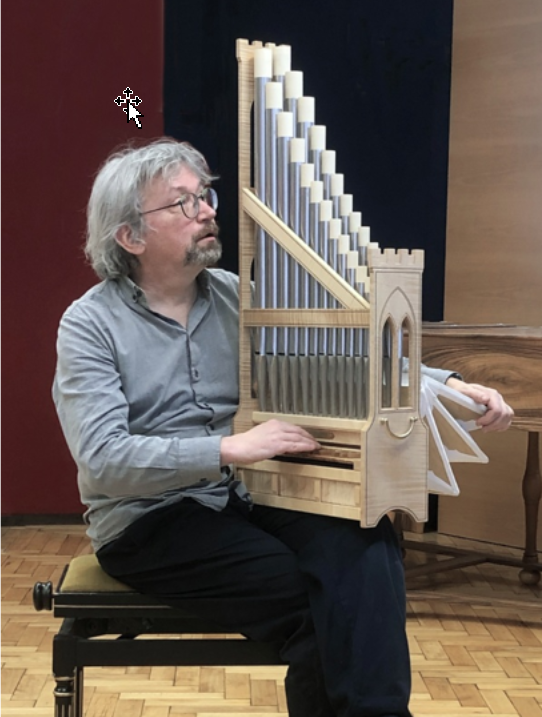
Michael Meixner was born in 1962. He showed a musical inclination at a very early age and received a rich musical education from his youth onwards (violin, piano, organ), which he continued at the University of Music and Performing Arts Vienna (mdw) in composition (Neumann, Urbanner), church music (Planyavsky, among others) and conducting. For almost thirty years he has taught music theory, aural training, analysis, notation, improvisation and further subjects at the same institution, with a strong focus on the theory and practice of early music. His main interest lies in practical application, and accordingly he devotes himself above all to historically informed pedagogy in these fields.
Daniel Serrano
University of Music and Performing Arts Vienna (mdw)
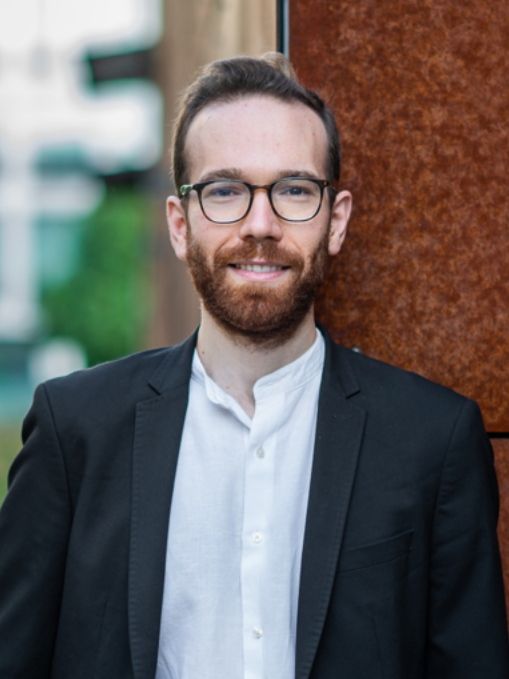
Daniel Serrano was born in Jaén (Spain) in 1991. After completing his violin studies at Musikene in San Sebastián, he studied composition with Wolfgang Suppan and Michael Jarrell and music theory with Gesine Schröder at the University of Music and Performing Arts Vienna (mdw), and since 2022 he has been pursuing a doctorate in musicology at the Hochschule für Musik und Theater “Felix Mendelssohn Bartholdy” Leipzig. He has taught music theory at the Leonard Bernstein Institute of the mdw since 2018, where he has held the position of Senior Lecturer since 2022, teaching aural training, aural analysis, harmony and counterpoint, into which he regularly integrates the improvisation of Renaissance polyphony. As a music theorist he focuses on the music of Salvatore Sciarrino and has also worked on Renaissance villancicos and Spanish counterpoint theory; he is also active as a composer.